
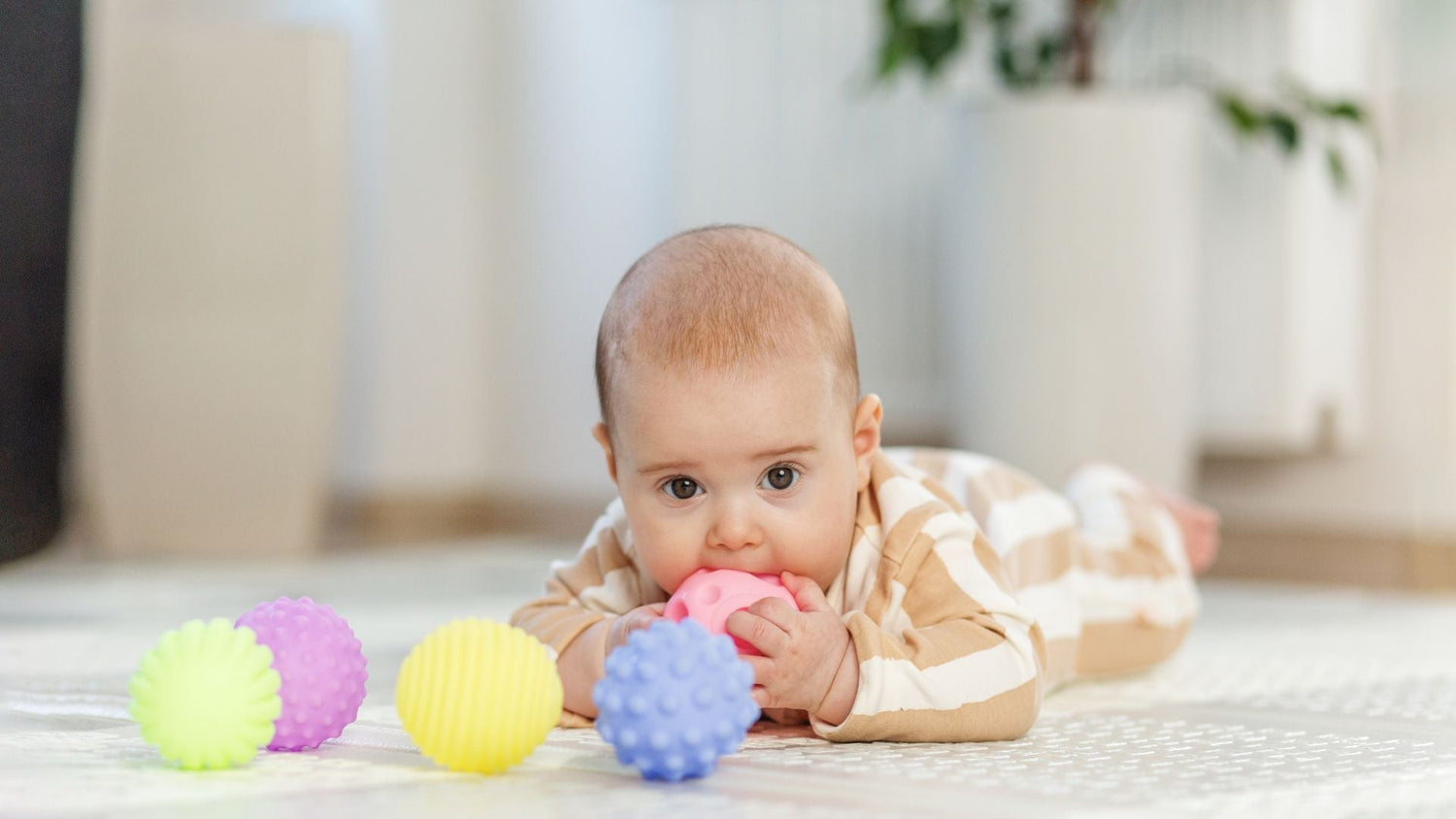
Look at your baby’s hands right now.
They’re waving. They’re reaching. They might be batting at something with a focus that looks almost intentional. That’s because it is - or at least, it’s becoming that.
Three months is the moment the motor system begins its transformation from reflex to intention. What’s happening in your baby’s hands this month is extraordinary. And the connection to self-feeding is far more direct than most parents ever realise.
Three-month milestones: the big leaps happening right now

According to NHS guidance, here’s what typically emerges around three months:
|
What you might notice |
What it means |
|
Baby reaching for objects |
Intentional movement begins — reflex gives way to deliberate action |
|
Bringing hands to midline |
Bilateral coordination starts — both hands working together |
|
Holding a rattle briefly |
Palmar grasp is strengthening and becoming more deliberate |
|
Batting at hanging toys |
Hand-eye coordination developing — vision directing movement |
|
Stronger head control in tummy time |
Shoulder girdle building — the foundation of all fine motor control |
|
Watching their own hands |
Hand awareness emerging — ‘I have hands and I can use them’ |
Source: NHS baby development guidance nhs.uk/conditions/baby/babys-development/
From reflex to intention: how your baby’s grip is changing
At birth, your baby’s grip was a reflex - automatic, triggered by touch, not chosen. By three months, something fundamental is shifting. Grip is becoming deliberate.
This transition - from reflex to intentional movement - is one of the most significant developments in the entire first year. It marks the beginning of your baby’s ability to interact with objects on purpose. To reach. To grasp. To explore.
What you’re watching is the nervous system laying down new pathways. Each time your baby swipes at a toy, misses, adjusts, and tries again, they’re not just playing - they’re building the neural architecture that will underpin every fine motor skill they develop for the rest of their life.
The grip progression sequence — where month three sits
Newborn grasp reflex → Palmar grasp (3–5 months) → Radial-palmar (5–6 months) → Radial-digital (7–9 months) → Pincer grip (9–12 months) → Tripod grip (12–18 months) — the spoon grip Your baby is right at the beginning of stage two. The palmar grasp that’s developing this month is the grip they’ll use when they first pick up a spoon at six months. This is not a coincidence. It’s a sequence.
Reaching and batting — what it really means
That swipe at the mobile above the changing mat. The bat at your face when you lean in close. These movements look random but they’re not - they’re your baby’s first experiments in voluntary movement.
At three months, reaching is still imprecise - your baby will overshoot, undershoot, and frequently swipe at air. But the intention is there. The brain is sending the signal; the body is still learning to execute it accurately.
What’s actually happening is a process called visuomotor integration - the brain learning to use visual information to guide motor movement. See something. Reach for it. Adjust. Try again. This is the foundation of hand-eye coordination, and it’s being built right now, one batting motion at a time.
By six months, this same system will be used to look at food, reach for it, and guide a spoon towards the mouth. The hardware is being installed this month.
Bilateral coordination: why two hands matter

One of the most important milestones at three months - and one of the least talked about - is the emergence of bilateral coordination: using both hands together.
According to NHS guidance, babies at this stage begin bringing their hands together at the midline of their body. This is a significant neurological event. It means the left and right hemispheres of the brain are beginning to communicate and coordinate.
Why does this matter for feeding? Because eating with a spoon is a bilateral activity. One hand holds the spoon; the other hand may stabilise the bowl. One side of the brain plans the movement; the other executes it. The bilateral coordination beginning this month is the direct precursor to that skill.
What the research tells us
Well-established developmental research confirms that bilateral hand use in infancy is a predictor of later fine motor proficiency, including writing, cutting, and self-care tasks. doddl baby cutlery is specifically engineered to encourage bilateral use from first weaning - one piece per hand - because this double-handed approach accelerates both motor development and mealtime independence.
Tummy time at 3 months - the foundation of everything
The NHS recommends tummy time daily from birth, increasing the duration as your baby grows. At three months, your baby should be managing several minutes at a time and beginning to push up onto their forearms.
But here’s what most tummy time guidance doesn’t tell you: tummy time isn’t just about neck strength. It’s building the shoulder girdle stability that underpins all fine motor control.
This is well-established in paediatric occupational therapy: the proximal muscles (shoulder, upper arm) must be stable before the distal muscles (fingers, hand) can develop precision. A child with weak shoulder stability will struggle to control their hand movements later. Tummy time is the investment that pays off at the dinner table.
Tips for tummy time at three months:
- Aim for 20–30 minutes total per day - broken into short sessions, not all at once
- Use a rolled muslin under the chest - gives extra lift and makes it easier for babies who are still building strength
- Get down to their level - your face directly in front of them is still the best motivation to lift their head
- Use a mirror - babies at this age are fascinated by faces, including their own
- Try a water mat - the visual stimulation gives extra incentive to push up and look
The direct line from these movements to using a spoon
Let’s make the connection explicit, because it’s remarkable.
The intentional reaching your baby is beginning this month will become the deliberate grasp they use to pick up a spoon at six months. The bilateral coordination emerging now will become the two-handed approach to eating - spoon in one hand, steadying with the other - that supports real mealtime independence. The shoulder strength being built through tummy time will become the stability that lets them guide a loaded spoon to their mouth without losing the food.
These movements are not random. They are step two of a sequence that your baby began at birth and will complete when they eat independently at the dinner table.
At doddl, we’ve spent 7 years studying this sequence with paediatric occupational therapists, Norland College, and the University of Exeter. Our founding insight - the one that led to our founder Cat redesigning baby cutlery from scratch - was that most feeding tools are built for adults to use with babies. doddl baby cutlery is built for babies to use themselves, at each specific stage of the grip progression.
The palmar grip your baby is developing right now? The short, contoured handle of doddl baby cutlery is engineered for exactly that grip. Not a scaled-down adult spoon. Not a guess. Seven years of working with OTs, built into the shape of a handle.
Hannah Jeffery, NHS Paediatric Occupational Therapist and doddl expert partner, puts it simply: early introduction of the right cutlery at the right developmental stage makes self-feeding achievable rather than frustrating - and that difference in early experience has a lasting effect on a child’s relationship with food and mealtimes.
Simple ways to support motor development right now
You don’t need equipment or a structured programme. The most powerful motor development activities are things you’re probably already doing:
- Offer objects to grasp - rattles, rings, soft toys of different textures. Let them hold, drop, and try again
- Daily tummy time - every day, building duration gradually
- Hang toys at batting height - gym bars or dangling toys that respond to being hit give instant, motivating feedback
- Encourage midline play - bring their hands together gently; support them in bringing both hands to a toy
- Talk about what they’re doing - “You’re reaching! You’ve got it!” - language and motor development are intertwined
What comes next: the 4–6 month hand development story
Between now and weaning at around six months, here’s what the developmental sequence looks like:
- Months 3–4: Palmar grasp strengthens; reaching becomes more accurate; bilateral coordination develops
- Months 4–5: Deliberate reach-and-grasp; beginning to transfer objects between hands; sitting with support
- Months 5–6: Sitting becoming more stable; radial-palmar grasp emerging; ready to begin weaning
- Month 6+: First solid foods; first spoon; the palmar grip they’ve been building now has a purpose
For more on what that looks like, our guides to sensory development at two months, hand-eye coordination development, and how to teach toddlers to use cutlery will walk you through every stage ahead.


Hinterlasse einen Kommentar
Diese Website ist durch hCaptcha geschützt und es gelten die allgemeinen Geschäftsbedingungen und Datenschutzbestimmungen von hCaptcha.