
Your baby is one month old. In the grand scheme of a life, that’s nothing. In terms of developmental progress, it’s extraordinary.
In just four weeks, your baby has gone from a brand-new human with no experience of the outside world to someone who recognises your face, responds to your voice, and is already building the foundations of movement, communication and independence.
Let’s look at what’s happening - and why it matters more than you might think.
What can a one month old baby do? The key milestones

Here’s a quick overview of what you might notice this month. Remember: all babies develop at their own pace. These are ranges, not deadlines.
|
Milestone area |
What you might notice at one month |
|
Vision |
Focuses at around 20–30cm; tracks slow-moving objects; most drawn to faces |
|
Hands & grip |
Strong grasping reflex — grips your finger placed in palm |
|
Movement |
Small arm and leg movements in response to stimulation |
|
Head control |
Brief head lifts during tummy time |
|
Communication |
Responds to familiar voices; beginning of social smile (6–8 weeks) |
Source: NHS baby development guidance (nhs.uk/conditions/baby/babys-development/)
Your baby’s vision at one month
At birth, a baby’s vision is blurry beyond about 20–30cm - which, not coincidentally, is roughly the distance between your face and theirs during a feed. Evolution knew what it was doing.
By one month, according to NHS guidance, your baby is starting to track slow-moving objects with their eyes and is especially drawn to faces, contrast (black and white patterns), and movement. Your face is, quite literally, the most interesting thing in their world right now.
This visual attention is the beginning of something important: the ability to look at an object, reach for it, and eventually bring it to the mouth. That sequence - see, reach, grasp - is the foundation of self-feeding. It starts here, with a newborn tracking your face across the room.
Early hand and grip development - why it matters more than you think

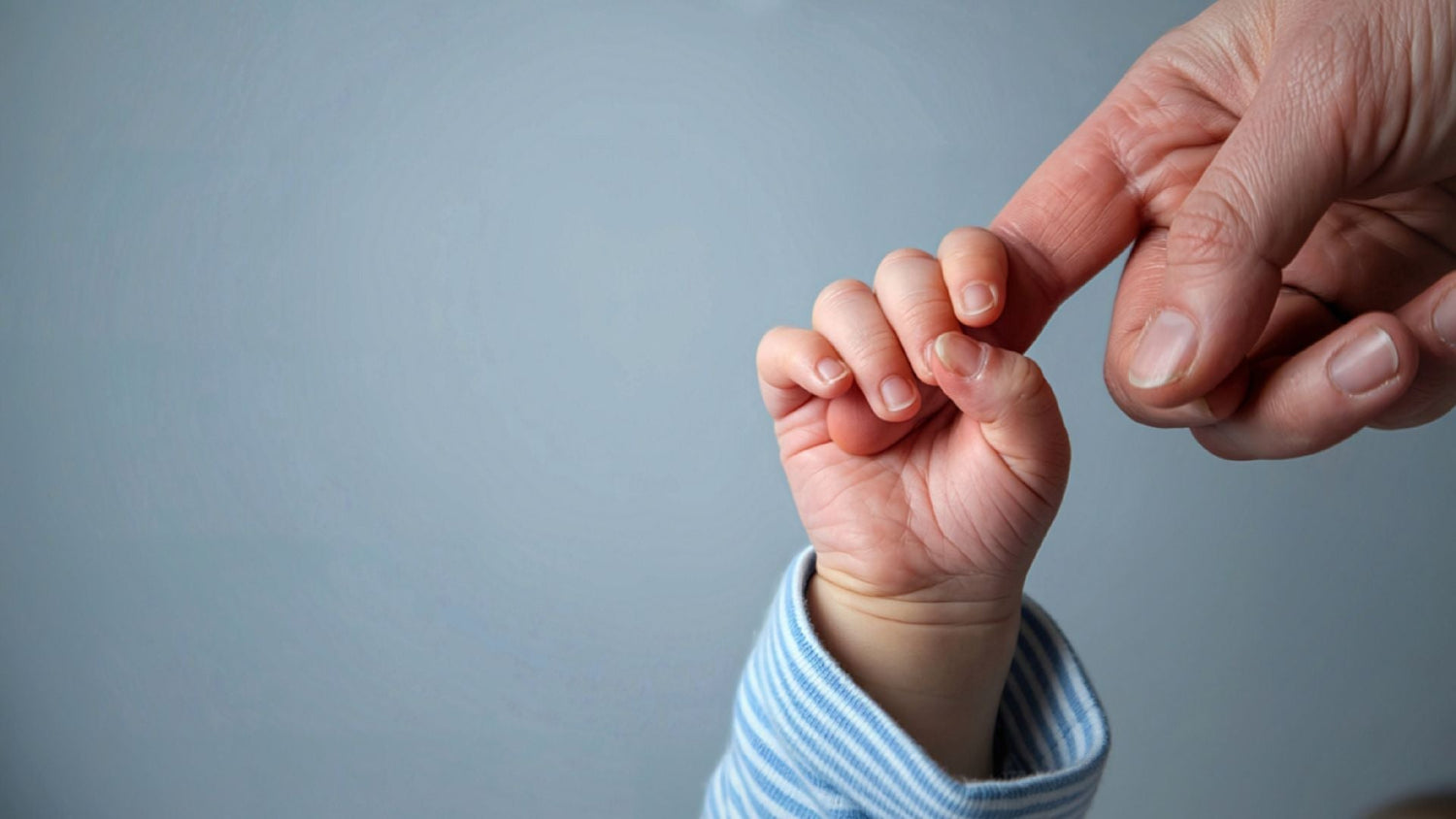
Ask most parents what they remember about their baby at one month and somewhere in the answer will be: “They grabbed my finger and wouldn’t let go.”
That’s the palmar grasp reflex - an involuntary grip triggered when something is placed in the palm. It’s one of the strongest reflexes a newborn has, and according to NHS guidance, it’s present and measurable from birth.
Here’s what makes it fascinating: this reflex is involuntary right now, but it’s the biological starting point of a developmental sequence that leads - over the next two years - directly to picking up a spoon and feeding independently.
The grip progression pathway looks like this:
- Newborn grasp reflex (now) - involuntary, triggered by touch
- Palmar grasp (3–5 months) - deliberate whole-hand grip
- Radial-palmar grasp (5–6 months) - using fingers and thumb together
- Radial-digital grasp (7–9 months) - thumb and first two fingers
- Pincer grip (9–12 months) - thumb and forefinger, precise pickup
- Tripod grip (12–18 months) - the pencil-holding grip; also the spoon grip
At doddl, we’ve spent 7 years working with paediatric occupational therapists to study this sequence in detail. Every product we design is built around a specific stage of this progression - because a tool that works with your child’s grip at the right moment makes all the difference. The grasping reflex your baby is showing you right now? That’s not random. It’s step one.
Our partner Fundamentally Children - a leading UK authority on early childhood development - recognises this grip progression as central to understanding children’s developmental needs. It’s one of the reasons they endorse doddl’s approach.
How your baby is already learning to communicate
At one month, your baby is listening - carefully. According to NHS guidance, babies begin responding to familiar voices from very early on, with the primary caregiver’s voice being particularly powerful. You may notice your baby turning towards sound, stilling when they hear you speak, or making small sounds in response.
This is the very beginning of turn-taking - the conversational structure that underpins all language development. You speak, they respond, you respond back. It feels like cooing at a baby. It is actually the foundation of communication.
The social smile typically appears between 6–8 weeks. If you’re reading this at four weeks, you’re right on the edge of one of the best moments in the whole first year. Hold tight.
Tummy time at one month - why it’s so important

The NHS recommends tummy time from birth, building up gradually as your baby grows. At one month, even a few minutes several times a day makes a real difference.
Here’s why it matters beyond just “strengthening their neck”: tummy time builds the shoulder girdle strength that underpins all fine motor control. The muscles your baby is working when they lift their head during tummy time are the same muscles that will eventually allow them to stabilise their arm while guiding a spoon to their mouth.
Think of it as the foundation that everything else is built on. Small investment, enormous long-term return.
Tips for tummy time at one month:
- Start on your chest - this counts as tummy time and is often easier for very young babies
- Aim for short sessions (a few minutes) several times a day rather than one long stretch
- Get down to their level - your face is their best motivation
- Use a rolled towel under their chest if they need extra support
What’s normal variation? (The reassurance section)
Development guides can make parents anxious. They’re not meant to. Here’s what’s important to know:
- Milestone ranges are wide. Every baby listed in any guide includes natural variation.
- Premature babies should be assessed against their corrected age, not birth age.
- Some babies are more alert; some are more sleepy. Both can be completely typical.
- If something feels off to you, mention it to your health visitor. Your instincts are a valid data point.
The NHS advises that if you have any concerns about your baby’s development, speak to your health visitor or GP. There is no such thing as raising a concern too early.
From month one to mealtime independence: the developmental thread
Every milestone your baby hits this month is a building block. The grip that holds your finger will become the grip that holds a spoon. The eyes that track your face will track food from the bowl to the mouth. The communication that starts with turning towards your voice will become the confidence to ask for more.
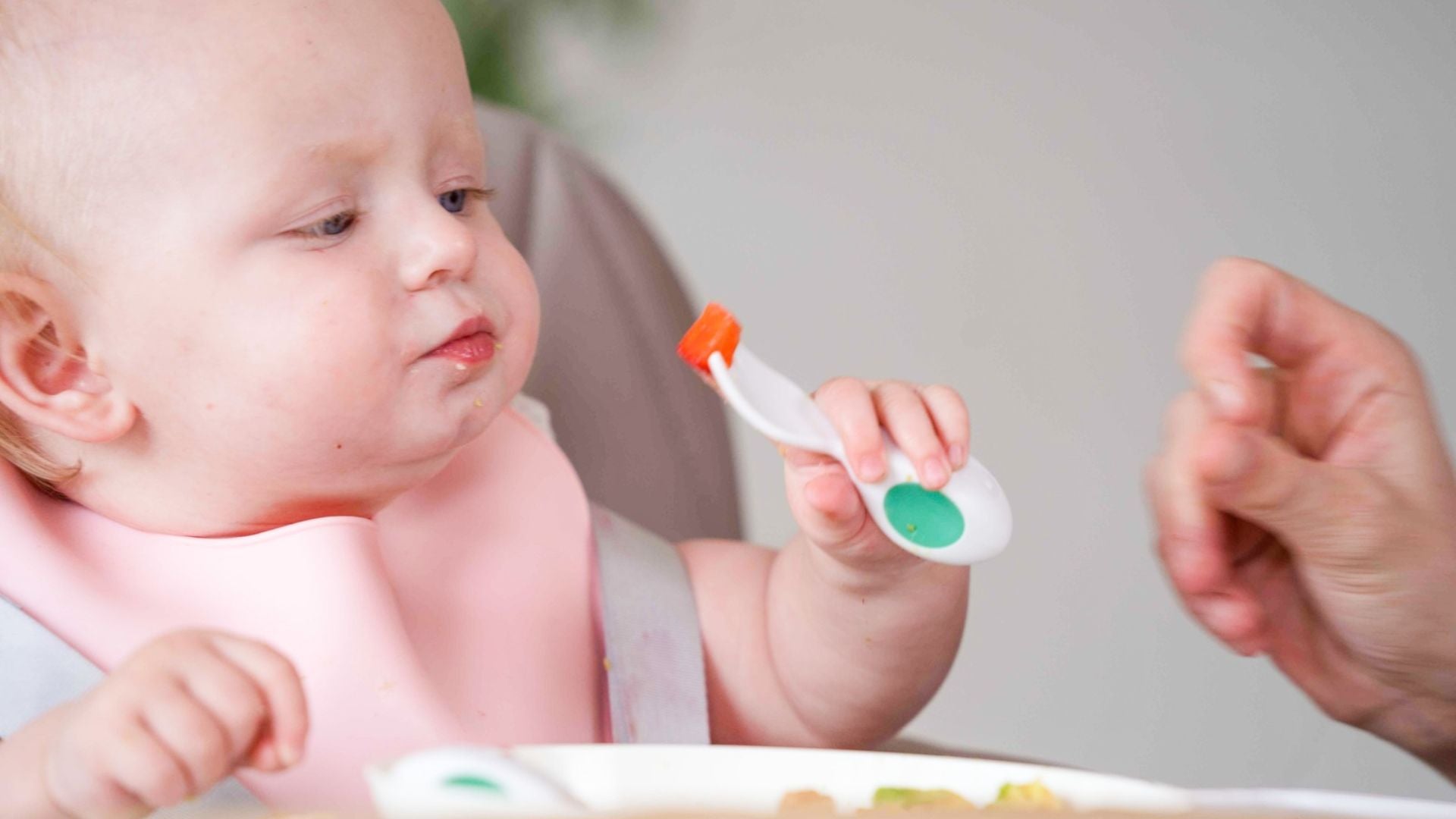
At doddl, we exist because someone - our founder Cat - watched this journey play out and realised that the tools most babies are given don’t work with it. They work against it. Standard baby spoons are designed for parents to spoon-feed with. doddl baby cutlery is engineered for the grip your baby will have at 6 months, and the grip they’ll develop through the months that follow.
Seven years of working with paediatric OTs, researchers at Norland College and the University of Exeter, and over a million families — all because we believe that every mealtime is a developmental opportunity.
Right now, you’re at the very beginning of that story. And it’s a good one. For more on what comes next, read about feeding in the first weeks and how hand-eye coordination develops in the months ahead.


Hinterlasse einen Kommentar
Diese Website ist durch hCaptcha geschützt und es gelten die allgemeinen Geschäftsbedingungen und Datenschutzbestimmungen von hCaptcha.